
📚
Organized by source
Keep vocabulary grouped by the book, manga, lesson, or podcast where you found each word. Context is part of what makes a meaning retrievable later.
Vocabulary practice for serious learners
Save vocabulary from the language you're studying, review it with active recall, and let smart timing do the rest. Built around how memory actually works.
Free plan available · No credit card required
Built on three principles of effective vocabulary learning
Producing a word from memory — not just recognizing it — is what turns short-term exposure into long-term knowledge.
Returning to a word just before you'd forget it is far more effective than daily drilling or never coming back at all.
Words learned in isolation fade quickly. Keeping a word tied to the sentence or book where you found it anchors the meaning.
No deck management. No configuration. Save a word, review it, and let the system handle the rest.
Keep vocabulary grouped by the book, manga, lesson, or podcast where you found each word. Context is part of what makes a meaning retrievable later.
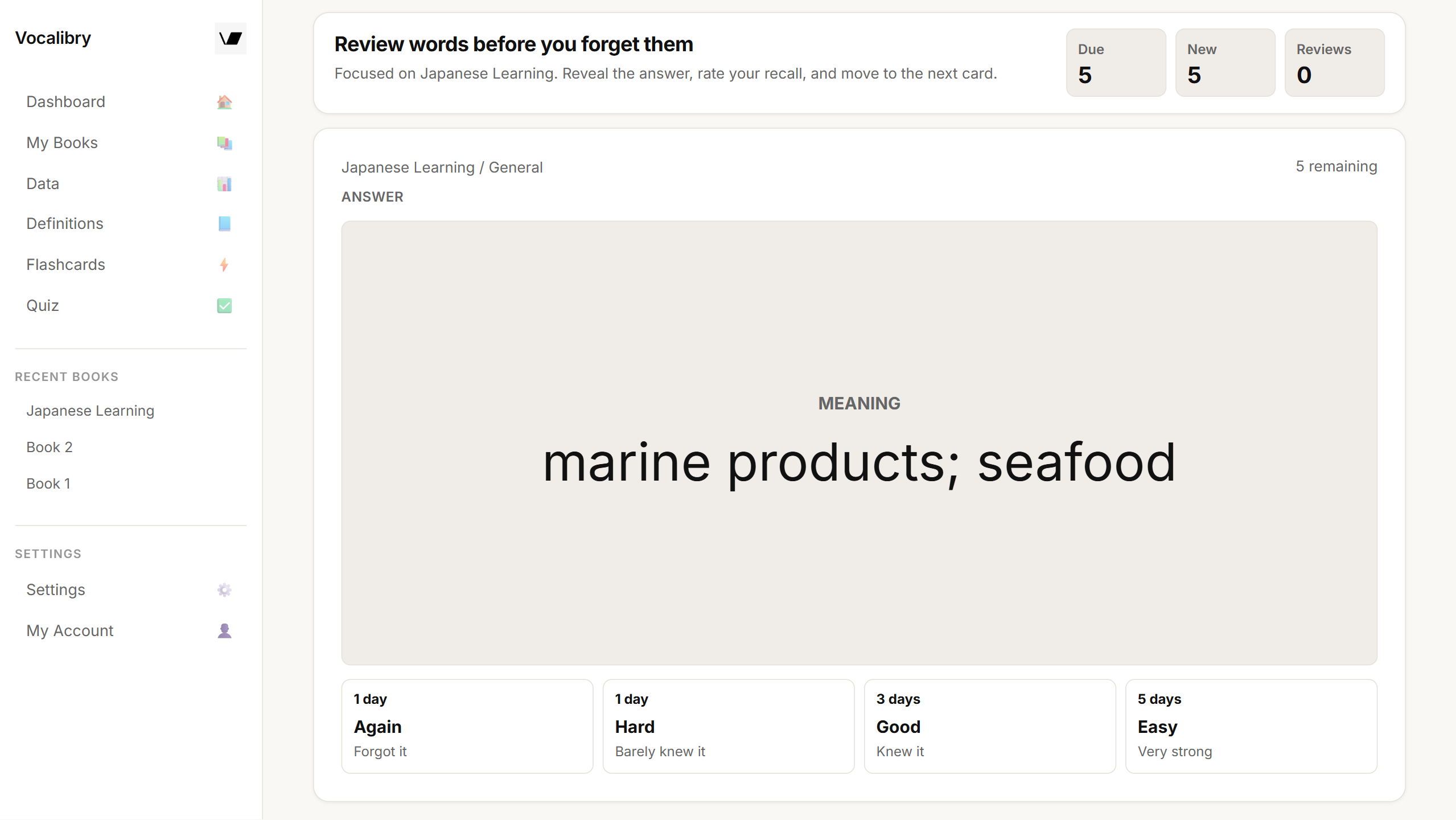
Practice producing the translation before the answer appears. Typing is harder than clicking — and that difficulty is exactly the point.
Your review queue resurfaces words just before you'd forget them, so every session is efficient and nothing gets permanently buried.
Study target-to-English and English-to-target. Recognizing a word and being able to produce it from English are two very different skills.
Streaks, quiz history, and word counts give you a concrete record of your study. Progress you can see is progress that keeps you returning.
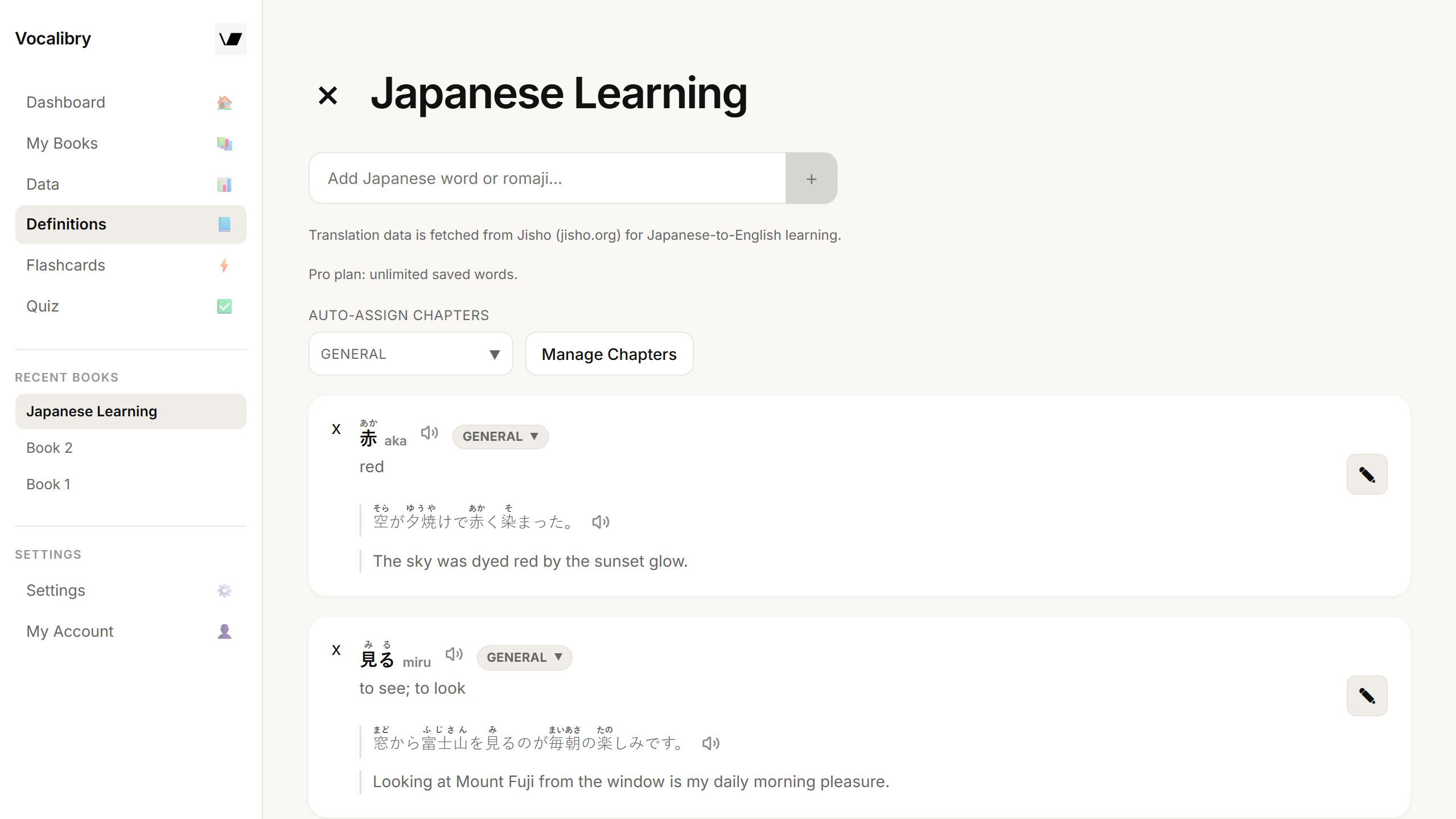
Kanji, kana, romaji, and English meanings in one card, reviewable in both directions. Built around how Japanese vocabulary actually works.
A simple, repeatable loop that moves vocabulary from "I looked it up" to "I actually know it."
When you look up a word while reading, watching, or studying, add it to your list. Attach the English meaning, a reading, or an example sentence.
Create a free account →Practice each word with flashcards or typed quizzes. The app prioritizes words you've missed most recently so every session is high signal.
See the study modes →Words you retrieve from memory — not just recognize — move into long-term storage. You stop re-looking up the same words and start knowing them.
Start learning now →Japanese study
Save kanji and kana with readings, English meanings, and example sentences. Review Japanese-to-English or English-to-Japanese. Every card is designed around how Japanese vocabulary actually works.
"I used to look up the same kanji four times and still forget it. Now I actually remember words because I review them at the right moment."
"The English-to-Japanese direction is what I was missing. Recognizing a word and being able to produce it from English are completely different skills."
"My words stay tied to the book I'm reading, which makes meanings feel real and grounded. Context really is everything."
Start free. Upgrade when you need more room to grow.
Free
Free forever
Start for freePro
Unlimited words, no ads
Start ProEnglish-speaking language learners who want a disciplined, low-friction way to review vocabulary from real input — books, manga, videos, lessons, or class notes.
Anki is powerful but requires significant setup and ongoing deck management. Vocalibry is focused: save a word, review it, move on. No configuration, no card design — just the practice loop.
The app supports English vocabulary books and Japanese-English study books with full kanji, kana, reading, and romaji support. It is best suited for English speakers learning Japanese.
Yes. Every study feature — flashcards, typed quizzes, Smart Review — is included in the free plan for up to 100 saved words. Most beginners won't exceed that limit for several months.
Yes. You can practice Japanese-to-English (see the kanji, recall the English meaning) and English-to-Japanese (see the English, produce the Japanese). Both directions are available on every plan.
Free plan available. No credit card required. Build the vocabulary habit that lasts.
Get started free